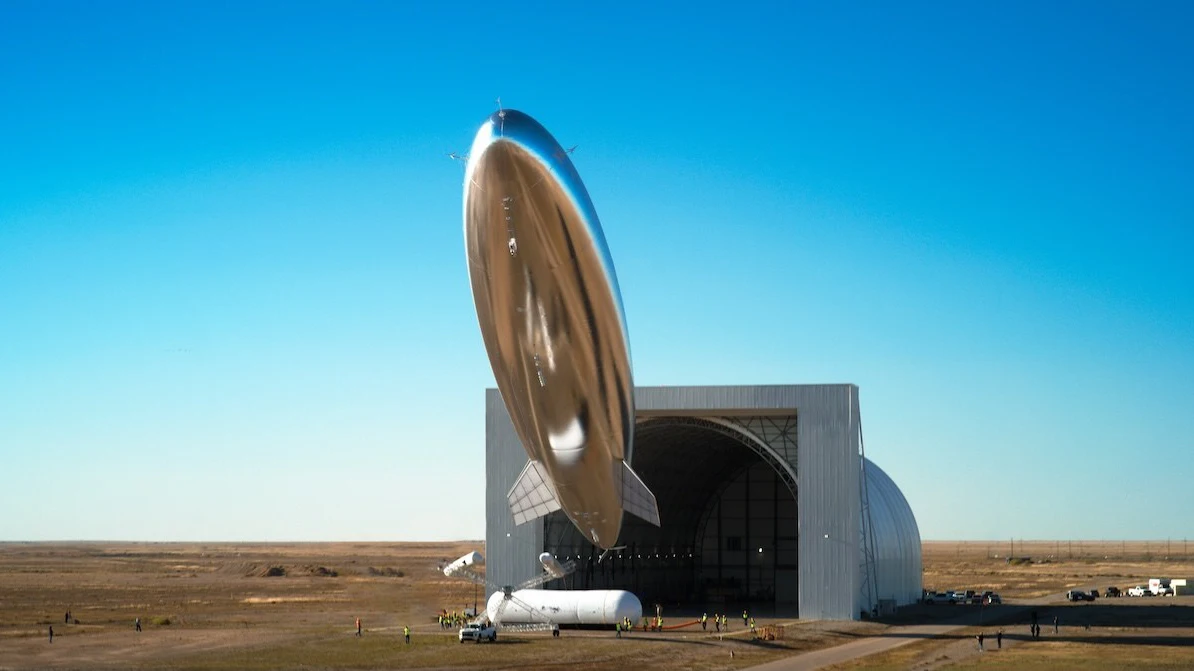

What Are High-Altitude Stations (Haps) Explained
1. HAPS Occupy a Sweet Spot between Earth and Space
Forget the binary of ground towers versus satellites orbiting. Platform stations operating at high altitudes operate in the stratosphere. They're typically between the range of 18 to 22 kilometers above sea level. an atmosphere that is in which the air is so quiet and predictable that a properly designed aircraft can remain in its place with astonishing accuracy. This is a high altitude to serve enormous geographic footprints in a single car, yet it is close enough to Earth that latency in signal transmission stays in the low range and that the hardware doesn't have to endure the harsh radiation-laden atmosphere of orbital space. It's a genuinely underexploited band of sky, and the aerospace world is only now taking the first steps to make it a reality.
2. The Stratosphere's Temperature is Much Calmer Than You'd Think
One of the most baffling things about stratospheric travel is the stability of the environment contrasted to the turbulent troposphere below. At the stratospheric level, the winds tend to be gentle and consistent that are crucial to stationkeeping — the capacity of a HAPS vehicle to remain in its position in a target area. For earth observation or telecommunications missions, even a few kilometres off position can affect coverage quality. Platforms specifically designed to provide true station keeping, such as the ones developed by Sceye Inc, treat this as a fundamental design requirement instead of as an add-on.
3. HAPS Stands for High-Altitude Platform Station
The name itself is worth unpacking. A high-altitude platform station is described in the ITU (International Telecommunications Union) frameworks by a platform that is one of the objects at an elevation of between 20 and 50 km with a fixed, but not exact stationary position relative to Earth. The "station" part is intentional — these aren't research balloons that travel across continents. They're observation and communications infrastructure, held on station conducting continuous missions. Think of them less as airplanes and more like high-altitude, flexible satellites with the ability of returning, being serviced as well as redeployed.
4. There are a variety of vehicle types under the HAPS Umbrella
There are many variations of HAPS vehicles look alike. The category covers solar-powered fixedwing aircrafts as well as lighter-than air airships and balloon systems that are tethered. Every one of these has tradeoffs related to payload capacity, endurance, and cost. Airships as an example can carry larger payloads for longer durations because buoyancy does all the lifting and frees up solar energy to power propulsion, stationkeeping, or onboard system. Sceye's strategy employs a lighter-than-air model specifically designed for airships to maximize capacities for payloads as well as endurance of the mission – a deliberate architectural selection that separates it fixed-wing competitors striving to beat altitude records with minimal useful burden.
5. Power Is the Central Engineering Challenge
It is a challenge to maintain a platform in the stratosphere over months or for weeks without fueling requires solving an energy-related equation with the smallest margin of error. Solar cells store energy in daylight hours, however the platform needs to be able to withstand the dark night with stored power. This is where battery energy density becomes vital. New developments in lithium-sulfur cell chemistry and energy density close to 425 Wh/kg have made stratospheric endurance mission increasingly feasible. With a boost in solar cell efficiency, the objective is a closed, dependable power loop with the ability to generate and store enough energy during each day to continue full operation for a long time.
6. The Coverage Footprint Is Large when compared to ground Infrastructure
A single high-altitude platforms station at 20km can be able to cover a footprint of several hundred kilometres. A typical mobile phone tower covers a few kilometres at best. This lack of symmetry renders HAPS an ideal choice for connecting in remote areas and regions that aren't well-served, or where building terrestrial infrastructure is economically infeasible. A single stratospheric vehicle can do what would otherwise require hundreds or dozens, if not thousands, of ground-based assets — making it one of the most likely solutions to the ongoing connectivity gap across the globe.
7. HAPS can carry multiple payload Types at the same time
As opposed to satellites that typically have a fixed mission plan at launch, stratospheric platforms could carry mixed payloads and be modified between deployments. One vehicle could have an antenna that delivers broadband along with sensors to monitor greenhouse gases, wildfire detection, or monitoring of oil pollution. This multi-mission flexibility is a single of the strongest economic arguments for HAPS investment — the same infrastructure could serve connectivity and climate monitoring simultaneously rather than having separate assets dedicated for every function.
8. The Technology enables Direct-toCell and 5G Backhaul Applications
From a telecoms viewpoint and a telecoms point of view, what the thing that makes HAPS unique is its compatibility with the existing ecosystems of devices. Direct-to cells allow phones of any type to connect with no special hardware, while the platform is essentially a high-altitude base station (High-Altitude IMT Base Station) — which is in essence a cell tower suspended in the skies. The platform can also be used for 5G backhaul to connect remote ground infrastructures to networks that are larger. Beamforming technology permits an application to steer signals precisely to where demand exists rather than broadcasting in an indiscriminate manner to increase the efficiency of the spectrum.
9. The Stratosphere Is Now Attracting Serious Investment
The research sector a decade ago is now attracted significant investments from major telecoms companies. SoftBank's partnership with Sceye for a planned national HAPS infrastructure in Japan and aiming to provide pre-commercial services in 2026, is one of the most significant commercial commitments in stratospheric connectivity to the present. This represents a transition from HAPS being viewed as an experiment to being seen as a viable and revenue-generating infrastructure — an endorsement that is important for the entire sector.
10. Sceye Represents a New Concept for a Non-Terrestrial Infrastructure
The company was founded by Mikkel Vestergaard based in New Mexico, Sceye has made itself known as a significant prospective player in the truly frontier-level aerospace. The company's desire to blend endurance, payload capabilities, and multi-mission capabilities is indicative of an understanding that stratospheric platforms are likely to become a constant layer of infrastructure across the globe and not just a novelty or a gap filler as such, but an actual third tier sitting between the terrestrial network alongside orbital satellites. For connectivity, climate monitoring, or disaster response, high-altitude platform stations are starting to look more like a concept that isn't as exciting rather than an inevitable part of how mankind monitors and connects the planet. Take a look at the recommended non-terrestrial infrastructure for blog recommendations including sceye haps softbank, HIBS technology, sceye haps payload capacity, Sceye Inc, softbank group satellite communication investments, Sceye stratospheric platforms, softbank satellite communication investment, sceye haps project updates, sceye careers, Stratospheric telecom antenna and more.

SoftBank'S Pre-Commercial Haps Services What's Coming In 2026?
1. Pre-Commercial Is a Specific and significant Milestone
The terminology matters here. Pre-commercial services constitute an exclusive phase in the development of any brand new communications infrastructure — past the stage of experimental demonstration, beyond proof-of-concept flying campaigns, and ultimately into zone where users actually receive real-time service in conditions that are similar to what a commercial deployment could look like. This means that the platform is station-keeping reliably, the signal is meeting quality thresholds that real-world applications rely on, the ground infrastructure is in contact with the spheric radio antenna accurately, and that the necessary regulatory permits are in place to operate in areas that are populated. The achievement of pre-commercial status is not a marketing milestone. It's an operation-related one for which the reason SoftBank has publicly committed to the goal through Japan in 2026, sets a high bar that engineering on both sides of this partnership has in order to get over.
2. Japan is the perfect country for this First
Making the decision to select Japan as the site for the stratospheric services of pre-commercialization isn't just a. The country has a number of characteristics that make it ideal for first place of deployment. The terrain of the country — mountainous terrain along with the thousands of islands inhabited by people as well as the long and complex coastlines -pose genuine problems in coverage that the stratospheric network is designed to tackle. The regulatory framework is advanced enough to manage the airspace and spectrum questions which stratospheric operations can raise. Its existing mobile network infrastructure, managed by SoftBank serves as the integration layer that an HAPS platform needs to connect to. The population of the country has the device ecosystem and technological literacy required to use a variety of broadband services without needing a period of technology adoption that could delay the meaningful use.
3. Expect initial coverage to concentrate on under-served areas and Strategically Important Areas
The pre-commercial deployments will not cover an entire country simultaneously. The more likely approach is targeted deployments that target areas where the gap between existing coverage and what stratospheric connection can bring is the largest, and where the strategic justification for prioritizing coverage strongest. In Japan's context, this means island communities that are currently dependent on high-cost and inadequate connection to satellites. They also include mountainous regions where terrestrial networks' economics never been able to sustain adequate infrastructure or coastal regions where disaster resilience is a priority in the national context due to the country's typhoon and seismic risk. These regions provide the most clear evidence of stratospheric connectivity's advantages and important operational information to improve coverage, capacity, as well as monitoring of platforms before the rollout to larger areas.
4. The HIBS Standard Is What Makes Device Compatibility Possible
One of the first questions that everyone is likely to ask about stratospheric broadband involves whether this requires special receivers or is compatible with standard devices. This HIBS Framework is High-Altitude IMT Base Station -is the result of a standards-based solution to this question. By adhering to IMT standards that power 5G and 4G networks worldwide, the stratospheric platform functioning as a HiBS is compatible with the device and smartphone ecosystem already operating in the coverage area. For SoftBank's Pre-commercial services the subscribers who are in area coverage should be in a position to connect to the stratospheric internet using their existing devices, with no need for hardware. This is a key prerequisite for any service that will attempt to reach the populace who live in remote areas that require alternatives to connectivity and are unable to spend money on specialist equipment.
5. Beamforming will determine how well capacity is distributed
A stratospheric based platform covering the entire area doesn't provide the same useful capacity across the area. How the available spectrum and signal energy are allocated to cover the whole area is an issue of beamforming capacity — the platform's ability focus the signal on where users and demand are most concentrated rather than broadcasting all over the vast areas of land that aren't being used. For SoftBank's pre-commercial phase, demonstrating that beamforming from an spheric telecom antenna is able to give commercially sufficient capacity to particular areas with a large coverage area will be crucial as will proving coverage areas. A large footprint that is thin and non-usable capacity does not prove much. Strategic delivery of genuinely suitable broadband to regions of service is the best evidence for the commercial model.
6. 5G Backhaul Application may Precede Direct-to-Device Services
Certain deployment scenarios the earliest and easiest to prove the feasibility of deploying stratospheric broadband isn't direct-to-consumer broadband, but 5G backhaul — connecting existing ground infrastructure in areas in which terrestrial backhaul is not sufficient or absent. A remote community might have some network equipment that is ground-level but may not have the high-capacity connection to the wider network that is necessary. The stratospheric technology that provides that backhaul link provides functional 5G coverage to areas served by existing ground devices without the need for end users to interface directly with the stratospheric network. This kind of scenario is easier for engineers to evaluate technically, and provides evidence-based and quantifiable outcomes, and enhances operational confidence in technology performance prior to when the more complex direct-to-device service layer is added.
7. "Edge of Sceye's Platform in 2025" sets the stage for what's possible in 2026.
The pre-commercial services target for 2026 depends entirely on what it is that the Sceye HAPS airship achieves operationally in 2025. Testing of station keeping, the performance of payloads under actual atmospheric conditions, energy system behavior across a range of diurnal cycle, and integration testing necessary to ensure that the platform's interface works to SoftBank's network architecture require sufficient maturity before commercial services can be launched. Updates on Sceye HAPS airship status until 2025 are not just peripheral reports, they are the most important indicators to determine whether the 2026 milestone is within the timeframe or creating the kind tech debts that pushes commercial timelines to the side. The technological progress that will be made in 2025 is the 2026 tale being constructed in advance.
8. Disaster Resilience is tested, not A Claimed One
Japan's high risk for disasters means that any stratospheric pre-commercial service operating within the country will certain to encounter conditions — eruptions of seismicity, typhoons disruptions in infrastructure that determine the platform's resilience as well as its ability to function as an emergency communications infrastructure. This isn't just a matter of the deployment. This is one of the most beneficial features. A stratospheric infrastructure that can maintain a stations and provides connectivity and observation capabilities during significant seismic or weather event in Japan demonstrates something that no amount of controlled testing can replicate. The SoftBank preliminary commercial phase will produce real-world proof of how the stratospheric infrastructure functions in the event that terrestrial networks fail -exactly the same evidence that all other potential operators of affected countries must examine before making a decision on their own deployments.
9. The Wider HAPS Investment Landscape Will Respond to What happens in Japan
The HAPS area has attracted significant investments from SoftBank and other companies, however more broadly, the telecoms and investors remain in an alert. Large institutional investors, national telecoms operators in different countries and government officials who are looking at stratospheric infrastructures for their own monitor and coverage needs are all tracking what happens in Japan with great interest. A successful launch of precommercial infrastructure -platforms on station functioning, services operating, and performances that meet thresholdsthat will help accelerate investment decisions across the entire sector with a speed that ongoing demonstration flights and announcements about partnerships do not. However, any delays or performance deficiencies will result in a recalibration of timelines across the industry. The Japan implementation has significant significance in the overall stratospheric communication industry, not just the Sceye SoftBank partnership specifically.
10. 2026 is the year we will know if Stratospheric Connectivity has crossed the Line
There's an arc in the development of any new infrastructure technology between the phase where it's exciting and the stage where it's actually being used. Aviation, electricity, mobile networks and the internet infrastructure all crossed that border at precise times — not when the tech was originally demonstrated, but when it was operational enough to be reliable that institutions and individuals began planning around its existence rather than the potential. SoftBank's initial commercial HAPS Services in Japan represent the most trustworthy future-oriented option for the time when stratospheric connectivity crosses that line. In the event that the platforms remain operational throughout Japanese winters, whether the beamforming service is sufficient for island communities, as well as whether they can operate in the types of conditions Japan typically encounters, will determine whether 2026 is remembered as the year the stratospheric internet became a reality or the year the timeline was rewritten. View the recommended softbank sceye partnership haps for blog advice including softbank investment in sceye, Mikkel Vestergaard, Stratosphere vs Satellite, Stratospheric broadband, what does haps stand for, Sceye Wireless connectivity, Closed power loop, Sceye Wireless connectivity, Sustainable aerospace innovation, what's the haps and more.